How did you first get involved in human factors?
I was running a group within the Human Factors division in BT. We worked on internal standards related to human interface and user interface design, and I was already attending ISO meetings on those topics. At the time, I was sending members of my team to ETSI because Human Factors had three subgroups, but when one person could no longer participate, I took over that role as well. Over time, ETSI HF shrank to one unit, and I became BT’s sole representative.
What kind of work did that involve at BT?
It covered a wide range of applications. We worked on things like telephone keypads such as their size, the feel of the keys, the springiness, really anything related to how people interact with ICT. At the other end of the scale, we also designed control rooms for network management systems. We carried out user trials, sometimes with members of the public and sometimes with maintenance staff. We were part of BT’s research and development work.
Was BT ahead of its time in this field?
We were certainly active, but we were not alone. AT&T had a major human factors group, and we worked with them in ITU-T. Sweden was also very involved, as were German companies such as Deutsche Telekom. Standardisation covered very practical matters, from telephone keypad layouts to tactile notches on bank cards for blind users. Over time, many of those companies disappeared or reorganised, and even the term “human factors” became less widely used, replaced by expressions such as “usability” or “user experience”.
How has the field changed over the years?
When I started, there were no mobile phones as we know them today, the first ones were really large boxes. Our work was focused on the fixed network and fixed telephones. But even then, people were imagining more advanced services. I remember finding an old video from before 1970 that showed ideas such as video phones and online banking. Some of it looks rather amusing now, but much of it was remarkably forward-looking.
What made ETSI EN 301 549 such a turning point?
That was the point when accessibility became much more visible and much more important to industry. From 2011 onwards, I was responsible for the development of EN 301 549 through its different phases. The first version supported ICT procurement in Europe, and the later revisions became Harmonised Standards for the Web Accessibility Directive and then for the European Accessibility Act. Because the standard directly affects product design, companies wanted to make sure it was clearly defined and workable.
Did that change who attended the meetings?
Very much so. Interest grew significantly when companies realised the standard would have a real impact on products and services. Apple, Microsoft and Google all became involved. Sony and Samsung also followed the work closely because television is covered by the Accessibility Act. The European Disability Forum joined ETSI as a member so it could participate more effectively. It became a very visible standard with a very broad impact, implemented in the 27 member states, Norway, Iceland, Lichtenstein, the UK.
Has the standard had an impact beyond Europe?
Yes. Canada, for example, has implemented EN 301 549 under the Accessible Canada Act through a one-to-one transposition into the Canadian standards system. That is particularly interesting because it is not simply a reference or an alignment, it is a direct adoption of the European standard. Other countries have also shown interest, referenced it in procurement or accessibility guidance or used it to align with EU market access requirements. This includes Switzerland, Turkey, India, Australia, Japan and I heard about Mexico as well.
Were you surprised to be named an ETSI Fellow?
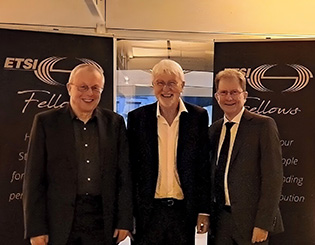
Yes, I was. I’m not someone who likes a fuss made, but I was very honoured. People have said many nice things about the way the EN 301 549 work was run, and it was very meaningful to have ETSI recognise that with the award. My family was very pleased as well.
And how does retirement feel?
My retirement was strongly encouraged by my wife. That probably says it all…

 From telephone keypads to European accessibility law, Michael Pluke has spent a career making technology more usable for everyone. As he retires and is named an ETSI Fellow, he reflects on the evolution of human factors, the rise of accessibility, and the global reach of EN 301 549.