
3 February 2026, Yoshihiro Nakajima, ISG NFV Chair (NTT Docomo)
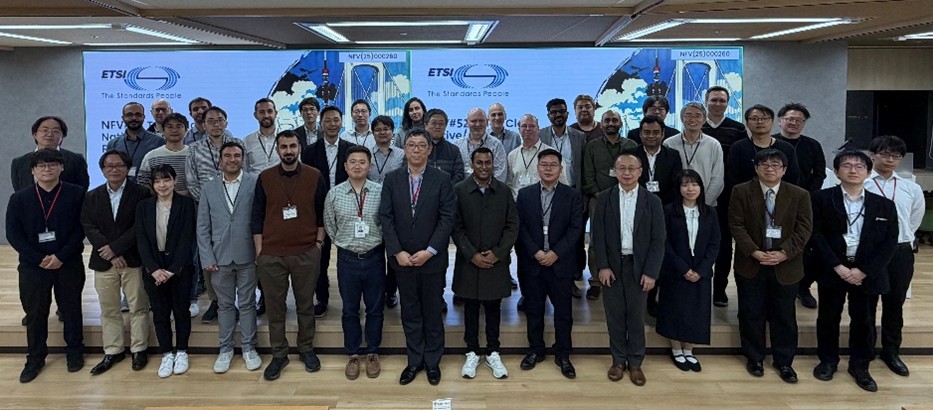
Rakuten Mobile: Realising Autonomous Operations with Agentic AI
Rohit Anand from Rakuten Mobile presented groundbreaking advancements in utilising Agentic AI to automate network operations.
- Agentic AI Ecosystem: By deploying specialised agents like the “SxC Agentic AI Engineer” and “Operations Supervisor,” Rakuten has successfully automated Root Cause Analysis (RCA) and impact analysis.
- Efficiency Gains: These initiatives have significantly reduced operational task time to just 10–15 minutes, with confidence scores exceeding 97%. The ultimate goal is to transition to a fully autonomous state.
- Sustainability: Through contributions to the O-RAN Alliance, their RIC (RAN Intelligent Controller) implementations are achieving up to 20% reduction in power consumption.
Huawei: A Paradigm Shift: From Connectivity to Connectivity + AI
Huawei highlighted that in the era of Mobile AI, telecom infrastructure is transitioning from CPU-centric, cloud-native architectures to xPU-centric, AI-Native paradigm. This new foundation supports hyper-converged clusters with peer-to-peer AI protocols such as A2A, enabling carrier-grade services, including intelligent agents and immersive experiences. The evaluation standard thus elevates to support diverse computing needs for real-time translation, high concurrency and superior accuracy, moving beyond simple bandwidth to “User Experience + Intelligent Services.”
NTT DOCOMO: Telco Cloud Evolution and AI-Driven Monitoring
Representing NTT DOCOMO, the team discussed managing a vast network with over 90 million subscribers and tens of thousands of base stations.
- Automation at Scale: Using bare metal container distribution and their “IMS” cluster management tools, DOCOMO has automated the deployment of thousands of edge sites.
- Next-Gen Architecture: They proposed a new Telco Cloud Automation architecture using Kubernetes Custom Resource Definitions (CRDs) to handle Telco Cloud-specific logic.
- AI Agents: The vision for the future involves AI agents utilising “Git” (design phase) and “Graph” (runtime) repository data to automatically provision, monitor, and troubleshoot the cloud continuum.
Overcoming Challenges and Looking Toward Release 7
Despite the impressive AI technological progress, the roundtable addressed significant challenges, such as industry fragmentation across open-source communities and standards, and the increasingly short life cycles of software products.
The event concluded with a forward-looking discussion on ETSI NFV Release 7, which aims to build upon the architectural framework designed in ETSI NFV Release 6 and harmonise AI-Native innovations. The consensus was clear: the integration of AI is no longer optional—it is the foundation for the next decade of telecommunications.
