22 July 2026, Brendan Hasset (NFV TSC Chair)
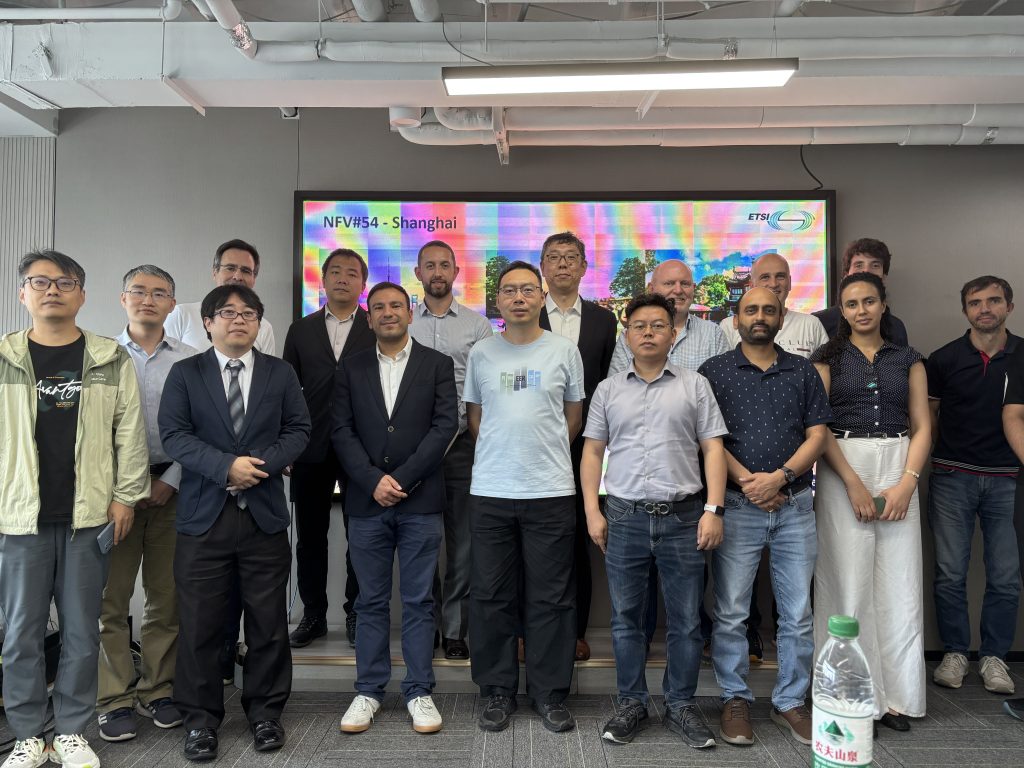
ETSI NFV Community Gathers in Shanghai for NFV#54
The ETSI Industry Specification Group for Network Functions Virtualisation (ISG NFV) held its 54th plenary meeting (NFV#54) from 22 to 26 June 2026, in Shanghai, China.
ETSI NFV delegates discussed the recent announcement that a new TC NET will be established, and the consequences for the NFV ISG. The terms of reference for the NFV ISG were updated to describe the expected scope of work during 2027 before merging into TC NET. Focus areas will be:
- Advanced network architecture, technical interface, and descriptor specifications.
- Cloud infrastructures and framework optimisations for Artificial Intelligence (Cloud for AI / AI-native infrastructure).
- Support for Telco Cloud Applications and AI-native (including agentic AI) functions.
- Intent-driven automation, declarative configurations, and GitOps-based operational models tailored for telco workloads.
- Unified data management, advanced AIOps/MLOps capabilities, and cloud-native scalability.
It was also agreed that NFV maintenance activities will cover only Release 5 and Release 6. The NFV leadership will apply for an extension of the ISG term until the end of 2027.
Recently, the ISG has been focusing on new architecture and feature specifications, which rely on the expertise of delegates across different working groups. This has resulted in many cross-WG meetings every week, which have increased complexity and workload. To ease discussions in the ISG, it was agreed to merge the existing EVE, SEC and SOL working groups into the IFA working group. Going forward, the IFA working group will be the only working group.
For Release 6 and Release 7 planning, the TSC endorsed a new schedule to align with a possible merge with TC NET. According to the new plan, edition 621 will be extended to the end of 2026, edition 631 will be moved to 2027, and edition 641 will be removed.
With regard to ongoing technical work, Release 5 is now almost completed. Stages 1 and 2 work has been completed, while the final specifications for stage 3 are almost ready for approval.
In Release 6, the Telco Cloud architecture (NFV008-1) was enhanced to describe the PaaS Service Management function and TCP and TCI services relationship. The Telco Cloud requirements (NFV008-2) specified security functional requirements, certificate management functional requirements, subscription and notification requirements for TCP and TCO functions, and functional requirements for physical resource LCM.
Also in Release 6, there was good progress in Telco Cloud Infrastructure Descriptors (NFV009-1) and Telco Cloud Application Descriptors (NFV009-2). Work has started on new specifications for Telco Cloud Infrastructure service interfaces (NFV010-1) and Telco Cloud Platform service interfaces (NFV010-2).
There was also strong progress in Release 7 studies. The report on new infrastructure resources for NFV (EVE023) and the report on Serverless and other application virtualisation forms in NFV (EVE025) are almost completed. Work continues on the report on Computing Network Convergence (EVE026), report on Data Management in NFV (EVE028), report on Platform for Agentic Apps (EVE029), report on enhancing TC orchestration functionality for agentic apps (EVE030), and report on Telco Cloud Infrastructure support for telco AI Agents (EVE031).
On Wednesday 24th a joint workshop between ETSI ISG NFV and ITU-T SG13 took place. The joint ITU-T SG13 and ETSI ISG NFV Workshop, “AI-Enabled Network Evolution: Cloud Native & AI Innovation for Telco Future”, brought together standards experts, industry leaders, operators and technology providers to discuss the evolution of cloud-native and AI-native technologies for future telecommunications networks. The event highlighted the growing collaboration between ETSI ISG NFV and ITU-T SG13, with a common objective of accelerating the development of next-generation Telco Cloud architectures and AI-enabled network infrastructures.
The workshop opened with welcome remarks from Seizo Onoe, Director of the ITU Telecommunication Standardisation Bureau (TSB), and Kazunori Tanikawa, Chair of ITU-T SG13, who emphasised the importance of international cooperation in shaping future cloud-native and AI-native networks.
Standardisation Perspectives
The first session focused on the latest standardisation activities within both organisations.
Representing ETSI ISG NFV, Dr. Kostas Katsalis, ETSI ISG NFV IFA Vice Chair, presented the latest progress of the ETSI NFV Telco Cloud Architecture, outlining how ETSI NFV Release 6 is evolving beyond traditional NFV-MANO towards a comprehensive Telco Cloud Architecture. The presentation highlighted ongoing work on cloud infrastructure, management, orchestration, platform capabilities and architectural evolution supporting cloud-native and AI-native deployments.
Tingting Zhang, Rapporteur of ITU-T SG13 Question 18/13, presented the latest ITU-T standardisation work on cloud-native and AI infrastructure, providing an overview of SG13 activities supporting future telecom systems and AI-enabled network evolution.
The discussions demonstrated that ETSI ISG NFV and ITU-T SG13 share complementary visions for the future evolution of telecommunications infrastructure, creating strong opportunities for closer technical collaboration.
Industrial Perspectives
The second session showcased practical deployment experiences and industrial viewpoints from leading organisations. Presentations included Rakuten Mobile, discussing ETSI NFV Infrastructure and Platform Management in Telco Cloud Release 6; ETSI ISG NFV, presenting its approach to managing cloud-native and AI infrastructures; China Mobile, sharing practical experiences and future directions for cloud-native and AI-native evolution and GTI Alliance, presenting industrial perspectives on the transition from 5G-Advanced towards AI-native networks.
These presentations illustrated how standards are being translated into operational deployments while identifying future requirements for cloud-native management, AI integration and automation.
The workshop concluded with a roundtable discussion involving ETSI ISG NFV and ITU-T SG13 experts, exploring future areas of cooperation between the two organisations. Participants discussed opportunities to strengthen collaboration on cloud-native architectures, AI-native infrastructures, orchestration, management and emerging telecom technologies.
Continuing Collaboration: The successful joint workshop demonstrated the shared commitment of ETSI ISG NFV and ITU-T SG13 to fostering open dialogue, exchanging technical expertise and aligning standardisation efforts that will help shape the future of Telco Cloud technologies.
In summary, the NFV#54 plenary meeting provided a key forum for progressing telco cloud-native and AI-native technologies. Through in-depth technical exchanges, strong collaboration, and a shared forward-looking roadmap, the NFV community continues to foster innovation and influence the ongoing transformation of telecommunications networks.
Next meeting
NFV#55 Tokyo, Japan on 14-18 September, 2026