
12 March 2026, Waleed Akbar, F5G Contributor, CTTC
The progressive evolution from F5G to F6G introduces emerging challenges for worldwide operators, especially regarding rising energy footprint, carbon emissions and greenhouse gas emissions. In this perspective, the ETSI ISG F5G community is placing a strong emphasis on the greener, carbon-aware and energy-efficient fixed networks. One of the latest contributions to this effort is a recently published article at IEEE Communications Magazine, presents an energy-efficient monitoring and management framework for F5G-Advanced (F5G-A) networks. The publication focuses on the initial experimental validation of the proposed design in ADRENALINE testbed, demonstrating its potential to enable greener operations and improve sustainability.
Modern telecom networks spanning packet, optical, compute and environmental control (i.e. HVAC) subsystems are becoming increasingly complex and power hungry. As highlighted in the publication, datacentre energy consumption alone is expected to surge from 200 TWh (2016) to 2967 TWh by 2030, intensifying pressure on the network operators to adopt greener solutions. F5G group recognises energy efficiency as one of the core objectives for the future networks. Yet it is true that energy intelligence requires visibility; the operators must understand how energy is being consumed across different technological domains, even the HVAC systems that count for significant portion of overall network power usage. This is the gap our proposed framework is directly addressing.
The proposed architecture is a multi-layer, distributed monitoring designed to collect, process and analyse near real-time energy consumption and generation metrics across all F5G-Advacned domains. It includes:
- Energy probing layer: Gathers telemetry via software agents, hardware sensors and APIs from both energy consumption and generation sources.
- Energy streaming layers: Processes telemetry in real-time with high-throughput and reliability.
- Energy storage layer: Stores the collected data for visualisation, analysis and long-term monitoring.
- Energy analytics layer: Perform real-time and historical analyses to derive insights and support decision-making.
Implementation of EEMS for F5G A
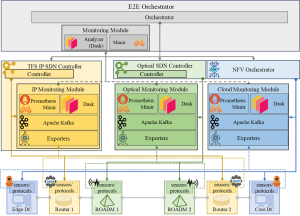
Figure 1: A lab testbed deployment of the proposed energy efficient monitoring and management system
The major focus of publication is the lab-based experimental validation. The framework was implemented at Centre Tecnològic de Telecomunicacions de Catalunya (CTTC) and demonstrated on the ADRENALINE testbed which integrates multiple domains:
- IP domain: Two packet routers
- Cloud domain: Datacenter compute nodes
- Optical domain: ROADMs and optical transponders
To monitor the energy consumption, each device in a network is instrumented with a physical sensor installed on the power cable, to measure the real-time power consumption. Besides hardware-level metrics, the compute domain employs Scaphandre to provide application-level energy monitoring while the packet domain utilises SNMP to retrieve the energy-level metrics of the router. Where supported, OpenConfig data models can serve as an additional mechanism to retrieve energy metrics. The optical domain currently lacks built-in telemetry capabilities for power consumption.
The closed-loop automation process begins with collection of energy consumption and network utilisation using domain-specific telemetry. These exporters retrieve measurements via supported protocols and sensors and periodically published them on the Apache Kafka messaging system. The Analytics function (e.g., Dask-based processor) detects the underutilised ports in near real-time and forwards alerts to E2E controller. Upon receiving the alert, it decides based on the constraints and service-level requirements to whether the identified ports may be deactivated. If permitted, the E2E controller instructs domain controllers to reroute traffic and subsequently disable underutilised port. Finally, the resulting impact on the overall energy consumption is measured to verify the effectiveness of the decision.
The results presented in this publication validate the technical feasibility and real-world practicality of the proposed energy-driven approach. The framework serves as a steppingstone towards future sustainable, energy-aware networks architectures. Most importantly, it supports the “Green Agile Optical Network” dimension of F5G-Advanced networks.
