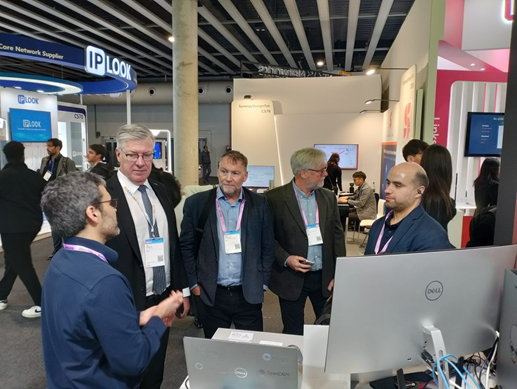
Lluis and Hesam introducing the NaaS platform to ETSI Director General and ETSI Director of Strategy & Innovation

19 March 2026, Lluis Gifre Renom (CTTC) ISG F5G contributor
The work aligns with specifications and architectural principles from ETSI ISG F5G, ETSI ISG ZSM, IETF, and CAMARA, and is built upon open-source components including ETSI SDG TeraFlowSDN (TFS) and ETSI SDG Open Source MANO (OSM). The proposed solution highlights the capabilities of F5G-Advanced networks, demonstrating how high-capacity optical infrastructures combined with automated network management can support demanding immersive VR services. The platform incorporates service-aware telemetry using IETF Service and Infrastructure Maps (SIMAP) and an AI analytics engine that enables predictive service assurance through closed-loop automation. The demonstration showcased how immersive VR applications such as cloud-based VR gaming can dynamically benefit from network adaptation. A custom VR Tennis game was used to illustrate the impact of network impairments on user experience and how the platform automatically adapts available infrastructure resources to maintain the required service performance.
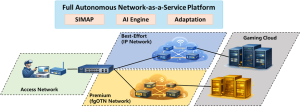
At MWC 2026, the Centre Tecnològic de Telecomunicacions de Catalunya (CTTC) and Huawei Technologies (Canada) showcased the third evolution of a standards-based Network-as-a-Service (NaaS) platform designed to support immersive VR applications through programmable and fully autonomous network infrastructures. The platform aligns with the vision of ETSI ISG Fifth Generation Fixed Networks (F5G) and ETSI ISG Zero-touch network and Service Management (ZSM), combining high-performance optical transport with automated service management capabilities. The solution builds upon open standards from SDOs including ETSI, IETF, and CAMARA, and integrates open-source technologies such as ETSI SDG TeraFlowSDN (TFS) for programmable transport network control and ETSI SDG Open Source MANO (OSM) for end-to-end service orchestration. The goal of the PoC was to demonstrate how a standards-based NaaS platform can provide full autonomous service assurance for immersive applications, enabling networks to dynamically adapt infrastructure resources according to service requirements while optimising resource utilisation and operational cost.
The development of this platform has progressed through multiple demonstration phases. The first phase, showcased at MWC 2024, established the foundations of the NaaS platform by exposing CAMARA Quality-on-Demand (QoD) APIs, allowing applications to dynamically request network connectivity services tailored to their performance requirements. In this phase, the platform demonstrated the provisioning of optical network slices supporting immersive applications. The second phase, presented at MWC 2025, expanded these capabilities by introducing dynamic service classification and differentiation mechanisms. The setup incorporated a dedicated IP transport network for best-effort traffic alongside a fine-grained Optical Transport Network (fgOTN) capable of providing guaranteed Quality of Service (QoS). This allowed the platform to differentiate between application flows and allocate the appropriate transport infrastructure depending on service requirements. Building upon this foundation, the third phase presented at MWC 2026 introduces predictive and full autonomous service assurance capabilities. A key enhancement in the NaaS platform is the integration of IETF Service and Infrastructure Maps (SIMAP), an AI Analytics Engine to forecast network performance and prevent Service Level Agreement (SLA) violations.
The demonstration used an immersive cloud-based VR application to illustrate these capabilities. A custom VR Tennis game running in the cloud allowed visitors to experience how network impairments can directly affect user Quality of Experience (QoE). The NaaS platform continuously monitored the network conditions supporting the application and dynamically adapted the transport infrastructure to maintain the required performance levels. Through this interactive setup, the demonstration illustrated how F5G-Advanced networks combined with autonomous network management principles from ETSI ZSM can support immersive digital services while optimising the use of network resources.
Lluis Gifre (CTTC) and Hesam Rahimi (Huawei Canada) performed the demonstration of the developed NaaS platform in the CTTC booth (CS Stand CS210). A VR headset and the custom VR Tennis cloud game were used to show the operation of the NaaS platform, and it raised interest from congress delegates. We had the visit of ETSI delegation composed of ETSI Director-General Jan Ellsberger and ETSI Director of Strategy & Innovation David Boswarthick, and delegation on ETSI ISG F5G.
Lluis and Hesam introducing the NaaS platform to ETSI Director General and ETSI Director of Strategy & Innovation
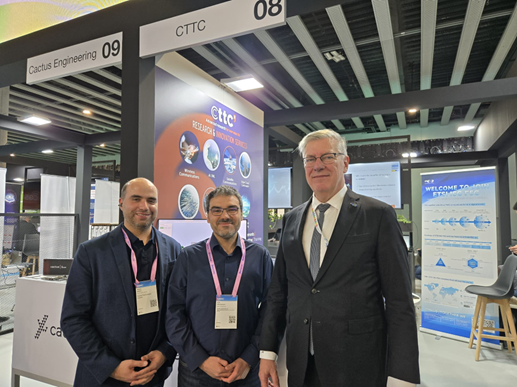
Institutional picture with ETSI Director General
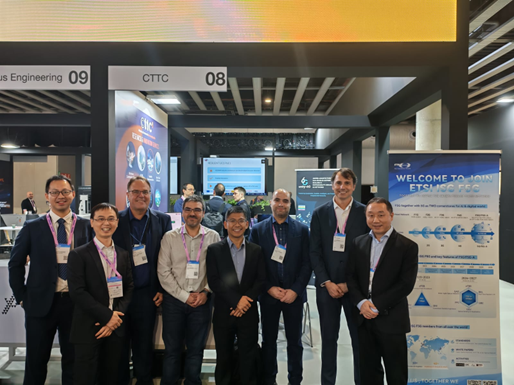
Institutional picture with ETSI ISG F5G delegation, and key contributors from Huawei Technologies and CTTC
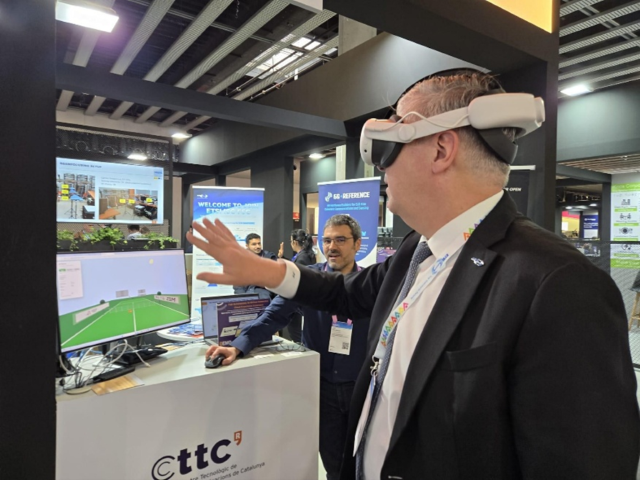
ETSI Director General trying the immersive VR Tennis game supported by the proposed NaaS platform
Within the NaaS platform, SIMAP provides a unified hierarchical representation of services and the infrastructure resources supporting them, enabling telemetry data to be organised contextually within the network topology and connectivity services landscape. Using SIMAP, the platform maintains a service-aware view of the underlying infrastructure, allowing telemetry information collected from network elements and cloud resources to be correlated with the services they support. This contextual representation enables more precise monitoring of transport slices and facilitates the identification of infrastructure conditions that may affect service performance.
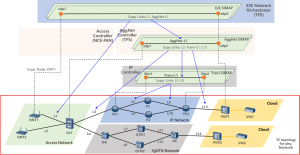
Representation of network topology through SIMAP and aggregation relationships
The AI engine processes telemetry data derived from the SIMAP model to analyze infrastructure conditions and forecast traffic evolution. By identifying early indications of potential performance degradation, the system can anticipate situations where best-effort network resources may no longer meet the SLAs required by the application. When such a condition is detected, the platform automatically triggers a closed-loop orchestration action. The service is seamlessly migrated from the cost-efficient best-effort infrastructure, typically based on IP transport and standard cloud resources, to a premium infrastructure supported by deterministic fine-grained Optical Transport Network (fgOTN) connectivity and premium cloud resources. This migration ensures that application performance remains within SLA requirements. Once the platform detects that the best-effort network conditions have stabilised and are again sufficient to support the required service performance, the system automatically demotes the service back to the best-effort infrastructure. This dynamic promotion and demotion mechanism enables the operator to preserve premium resources for situations where they are strictly required, while still delivering high-quality connectivity services to end users in a cost-efficient manner.
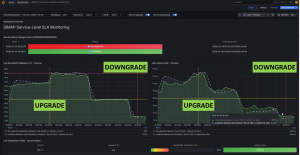
Real-time monitoring platform with notifications on fully-autonomous promotion
from Best-Effort to Premium (UPGRADE) and demotion back to Best-Effort (DOWNGRADE)
