
FLEX-SCALE Project

Co-funded by the European Union’s Horizon Europe research and innovation programme under Grant Agreement No. 101096909 and the Smart Networks and Services Joint Undertaking (SNS JU).
• Represented by Raul Muñoz
• FLEX-SCALE WP5 Leader
• CTTC (Spain)
• Head of Packet Optical Networks and Services
FLEX-SCALE has carried out disruptive research on next generation optical x haul networks and addressed a critical gap in ETSI-aligned transport SDN solutions that is the absence of a mature, standardised packet-optical control plane capable of managing advanced optical transport technologies integrated with packet technologies in a programmable, automated, and energy-efficient manner. The significant technical contributions delivered by FLEX-SCALE significantly increased the maturity, relevance and industrial impact of ETSI Software Development Group TeraFlowSDN (SDG TFS) deliverables.
FLEX-SCALE has carried out disruptive research on next generation optical x haul networks, with a particular focus on highly flexible optical switching nodes and advanced transceiver interfaces. FLEX SCALE targets unprecedented scalability, enabling interface rates beyond 10 Tb/s, link capacities exceeding 10 Pb/s, and optical node throughputs above 100 Pb/s. These capabilities are achieved through the exploitation of ultra high bandwidth photonic and plasmonic technologies, combined with efficient multi granular spatial and spectral switching based on ultra wideband (UWB) and Spatial Division Multiplexing (SDM). This architectural approach is essential to meet the stringent capacity, flexibility, and sustainability requirements of future 6G transport networks.
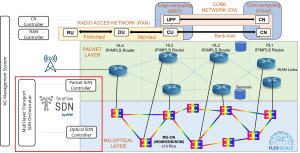
To operationalise the elasticity and programmability of the Multi Granular Optical Node (MG ON), FLEX SCALE adopts the cloud native ETSI TeraFlowSDN (TFS) controller as the autonomous transport network intelligence layer. Within FLEX SCALE, TFS integrates advanced telemetry, analytics, multi layer optimisation, and closed loop automation, along with native support for tightly integrated packet and MG ON functionalities. This unified control and orchestration framework enables packet optical backhaul networks to autonomously adapt to evolving service demands, delivering end to end QoS assurance while improving scalability, resilience, and energy efficiency.
A key contribution of FLEX‑SCALE lies in addressing a critical gap in ETSI‑aligned transport SDN solutions: the lack of a mature, standardised packet‑optical control plane capable of managing emerging high‑capacity optical transport technologies in a programmable and automated manner. This evolution was jointly driven by CTTC, CNIT/SSSA, and Ubitech, which played a leading role in the design, implementation, and integration of the TFS Controller extensions. These activities benefited from the MG‑ON agent developed by H&S and the transponder agent developed by HHI, both supporting emulated modes to enable seamless interaction with the TFS controller.
Within WP5, FLEX SCALE effectively kickstarted and significantly evolved the Optical Controller component of ETSI TeraFlowSDN, transforming it into a fully functional SDN controller for advanced optical transport networks. The controller was designed to natively manage multi granular optical nodes using model driven interfaces, supporting waveband division multiplexing (WBDM) and SDM technologies and enabling dynamic spectrum management beyond conventional WDM. FLEX SCALE further extended TFS with native support for novel high capacity optical transponders above 1 Tb/s, allowing coordinated control of wavelengths, wavebands, fibres, and transponders as first class entities in the control and management planes.
The technical contributions delivered by FLEX SCALE substantially increased the scope, maturity, and relevance of ETSI TeraFlowSDN as an ETSI Software Development Group deliverable. Enhancements to the Optical Controller include flex grid routing and spectrum assignment, waveband aware path computation, multi band operation, and optical protection mechanisms, all exposed through standardised northbound and southbound interfaces based on OpenConfig and NETCONF. These capabilities are tightly integrated with TFS end to end transport orchestration and packet layer control, enabling true packet optical coordination and dynamic virtual network topology (VNT) adaptation.
A major benefit of this integration is improved energy efficiency: by dynamically rerouting traffic at the optical layer to bypass intermediate packet routers and by switching off idle packet ports and line cards, FLEX SCALE reduces power consumption without compromising service level agreements. All features were contributed directly to the open source TeraFlowSDN codebase and validated in realistic distributed testbeds, ensuring their reusability and impact beyond the project lifetime.
In parallel, FLEX SCALE made a significant contribution to ETSI standardisation through alignment with ETSI ISG ZSM. The project designed and implemented a ZSM aligned closed loop automation framework integrated into TeraFlowSDN, enabling zero touch monitoring, analytics, policy enforcement, and automated reconfiguration across packet and optical domains. The framework follows key ZSM principles such as service centric management, intent driven control, and modular analytics and telemetry, while remaining fully interoperable with the underlying SDN control plane. Through this work, FLEX SCALE demonstrates how ETSI ISG ZSM concepts can be concretely realised in a production grade SDN controller, delivering tangible benefits in interoperability, operational automation, resilience, and sustainability for future 6G transport networks.
These results were showcased in the live demonstration entitled “Dynamic Adaptation of IP Virtual Network Topologies over Multi Granular (Wavelength and Waveband) Optical Networks Supported by ETSI TeraFlowSDN Multi Layer Control” at OFC 2025 and in the Post-Deadline paper entitled “Experimental Demonstration of Closed-loop Waveband protection in S-C-L Band IPoBDM Fiber Network Using Multi-granular Optical Nodes and TeraFlowSDN controllers” at OFC 2026, the world’s leading conference on optical communications.
