
Jérôme Dr. Royan

IRT b<>com - Deputy Director - Strategy and Performance of the Innovation
Dr. Jérôme Royan has produced a body of work that bridges advanced research and practical standardisation in the emerging field of Augmented Reality (AR) and Spatial Computing. He was a founding member of ETSI ISG ARF and has made numerous contributions to help define a unifying reference architecture spanning devices, networks, and cloud infrastructures to address the critical challenge of fragmentation in AR systems. His contributions stand out not only for their novelty and technical depth but also for their strategic impact on shaping a more interoperable and scalable AR and Spatial Computing ecosystem.
Dr. Jérôme Royan has produced a body of work that bridges advanced research and practical standardisation in the emerging field of augmented reality (AR) and Spatial Computing. His contributions stand out not only for their technical depth but also for their strategic impact on shaping a more interoperable and scalable AR and Spatial Computing ecosystem.
As a founding member and Vice-Chair of the ETSI Industry Specification Group on Augmented Reality Framework (ISG ARF), Jérôme has played a central role in addressing one of the field’s most pressing challenges: fragmentation. The AR landscape comprises heterogeneous hardware, software platforms, and service layers that often lack compatibility. Jérôme’s work has directly targeted this issue by helping define a coherent reference architecture that enables interoperability across these diverse components. This architecture provides a structured framework for AR systems – whether operating on-device, at the network edge, or in the cloud – to interact seamlessly.
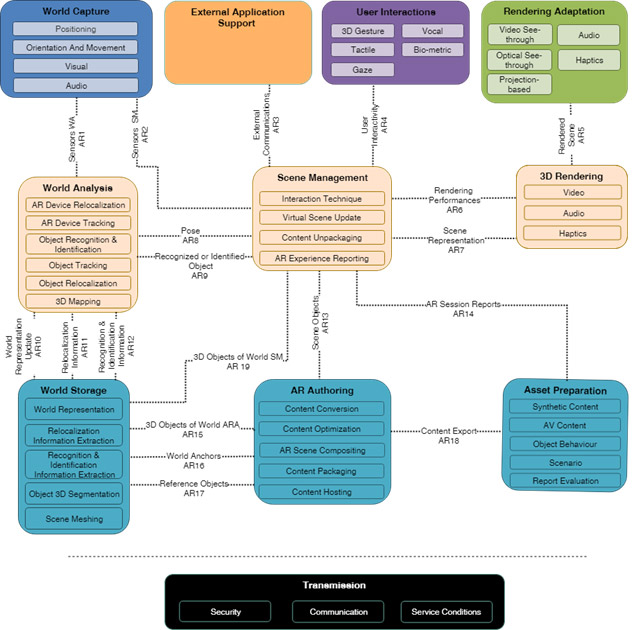
A key aspect of his contribution lies in translating complex research insights into actionable specifications. He has been instrumental in identifying critical use cases and technical gaps, ensuring that the standardisation work remains grounded in real-world needs. Building on this, he has contributed to defining APIs and interfaces that enable different AR modules – such as localisation, spatial mapping, and rendering – to communicate efficiently. These specifications are designed to be network-agnostic, ensuring compatibility across various infrastructures, including next-generation connectivity environments.
Jérôme’s research leadership at b<>com has further reinforced this standardisation effort. His work on pose estimation and spatial computing – core enablers of immersive AR experiences – feeds directly into the ISG ARF framework. By aligning cutting-edge R&D with standardisation goals, he ensures that the specifications are not only theoretically sound but also practically implementable and future-proof. This tight coupling between research and standards accelerates innovation while reducing the risk of technological silos.
Another significant dimension of his impact is his commitment to openness and ecosystem development. Jérôme has actively supported the implementation of SG ARF specifications in open-source environments, lowering barriers to entry for a wide range of stakeholders. This approach encourages participation from smaller companies, startups, and academic institutions, fostering a more inclusive innovation landscape. By promoting these solutions internationally, he helps build global consensus around interoperable AR technologies.
Overall, Jérôme’s work has helped lay the foundation for a scalable, competitive, and globally aligned AR ecosystem. By combining visionary thinking, rigorous research, and pragmatic standardisation efforts, he has contributed to reducing fragmentation, enabling interoperability, and supporting the emergence of a diverse and competitive market.
Reference of the deliverables, Dr Royan’s contribution has made a direct impact on:
ETSI GS ARF 003 v2.1.1 (2024-10): “Augmented Reality Framework (ARF) AR framework architecture”.
ETSI GS ARF 004-4 v1.1.1 (2023-01): “Augmented Reality Framework (ARF); Interoperability Requirements for AR components, systems and services; Part 4: World Analysis, World Storage and Scene Management functions”.
ETSI GS ARF 005 v2.1.1 (2024-12): “Augmented Reality Framework (ARF); Open APIs for the Creation, Management and Querying of the World Representation”.
