NFV#53 Plenary Meeting in Review

29 April 2026, Kostas Katsalis (NFV WG IFA Vice-Chair, Docomo)

The ETSI Industry Specification Group for Network Functions Virtualisation (ISG NFV) held its 53rd plenary meeting (NFV#53) from 9 to 13 March 2026 in Sophia Antipolis, France, at the ETSI headquarters.

Updates from the various Working Groups (WGs), which underpin NFV’s technical progress, formed a central focus of the plenary discussions.

  • EVE WG: WG EVE reported steady progress across most work items, with 27 approved contributions. These include new NFVI (EVE023), serverless and other application virtualisation forms in NFV (EVE025), Computing Network Convergence (EVE026), and Data Management in NFV (EVE028). Particular focus was given to Cloud4AI-related items: Platform for Agentic Apps (EVE029), enhancements to Telco Cloud orchestration for agentic applications (EVE030), and Telco Cloud infrastructures for agentic AI (EVE031). Use cases for managing AI agents in the Telco Cloud had sparked intense discussion. Topics including the deployment of AI agents via Telco Cloud provisioned agent runtime, provisioning dedicated security sandbox for AI agents, Agent memory management, elastic scaling and traffic scheduling for AI agents, as well as AI agent version upgrade and rollback, were actively debated and reached a high level of consensus. It was also agreed that EVE025 (serverless and new virtualisation forms) and EVE023 (new NFVI) will continue into Release 7.
  • IFA WG: WG IFA, together with SOL WG, kicked off work on Telco Cloud descriptors, namely NFV009-1 (Telco Cloud Infrastructure Descriptors) and NFV009-2 (Telco Cloud Application Descriptors). NFV008-1 (Telco Cloud Architecture) NFV008-2 (functional and non-functional requirements) have been published in drop 611. Both items will continue in Release 6, drop 621. IFA WG also discussed potential solution approaches for TCA descriptors, including possible extensions of de facto cluster management solutions and declarative API modeling.
  • SOL WG: Good progress was made on several active work items, including FEAT24 (Generic OAM), FEAT33 (Physical Infrastructure Management), TST010 (API conformance testing), SOL008 (OpenAPI), and SOL001 (NFV descriptors based on TOSCA specification). SOL WG also submitted several final drafts for NFV approval (NFV-TST010ed521, NFV-SOL005ed541, SOL025ed541). Updates to the work program were reported, including a three-month delay for SOL021 and SOL024, and the appointment of Umberto Fattore (NEC) as the new rapporteur for SOL026.
  • SEC WG: A joint IFA/SEC/SOL meeting focused on certificate management contributions related to NFV008-1 and NFV008-2. It was agreed that further work on certificate management will be handled within the SEC WG. The group also reviewed recent standards published by the Trysted Computing Group (TCG); an initial analysis indicated no impact on existing NFV SEC work items or specifications.

In addition, several discussions addressed Release 5 status, as well as planning for Releases 6 and 7, alongside the handling of incoming and outgoing liaison statements.

  • No changes to the overall Release planning since NFV#52.
  • For Release 5, Stages 1 and 2 are complete for edition 541, while Stage 3 is nearly complete, except for SOL021.
  • In Release 6, edition 611 is nearly complete, with ongoing work on ed621 items, including NFV003, NFV008-1, NFV008-2, NFV009-1, and NFV009-2.
  • For Release 7, discussions are currently focused on EVE WG activities and Cloud4AI-related items (EVE029–EVE031).
  • Six incoming liaison statements were handled, and three liaison replies were prepared.
  • A Memorandum of Understanding (MoU) was signed between ETSI and IOWN.
  • A NOC meeting was held on Tuesday, 10 March 2026, with participation from DOCOMO, China Mobile, BT, and Rakuten Mobile. Operators in the community believes that in the AI era, NFV will embrace new AI-native features and continue to evolve. On the other hand, the growing variety of device/user terminal types, as well as the proliferation of AI models, will pose greater challenges to interoperability standards.


Keynote Speech: “Building Flexible Infrastructure for Telco and AI”

On Monday 9 March, Sanjay Aiyagari (Red Hat) delivered a keynote titled “Building Flexible Infrastructure for Telco and AI.” The presentation outlined a modern Telco Cloud architecture designed to support AI-driven workloads, emphasising Kubernetes®-based platforms, automation, and multi-cluster management. Key challenges such as operational complexity, inconsistency, and limited observability were highlighted, along with proposed solutions including policy-based governance, secure software supply chains, and resilient architectures. The talk also emphasised AI enablement through GPU pooling, efficient inference mechanisms, and scalable deployment models. Emerging concepts such as agentic frameworks, disaggregated hardware, and standardised AI interaction protocols were also discussed.

A technical discussion followed, exploring how these approaches align with the evolving Telco Cloud architecture in NFV Release 6.


Joint Workshop with ETSI SDG OSM

On Tuesday 10 March, a joint workshop between ETSI NFV and SDG OSM was held. ETSI NFV presented the evolution toward a Telco Cloud framework driven by cloud-native technologies, automation, and AI, with a focus on new descriptor models (e.g., TCA, TCAC) and packaging approaches beyond traditional VNFDs.

SDG OSM presented updates from Release Nineteen, highlighting platform modernisation, an improved developer experience, and a declarative framework where applications are treated as first-class citizens. The architecture supports multi-cloud cluster management and continuous reconciliation of desired states using concepts such as KSU, profiles, and cluster intents. Overall, OSM is evolving toward a cloud-native, automated orchestration platform for distributed environments.


Joint Workshop with ETSI SDG OSL

Also on Tuesday 10 March, a second workshop took place between ETSI NFV and SDG OSL. OpenSlice presented a cloud-native orchestration approach for end-to-end telco services across edge, core, and public clouds. The architecture is based on Kubernetes principles, using CRDs and controllers for lifecycle management, and leverages GitOps (GITER) for distributed coordination. It also integrates AI through agent-based orchestration and MCP-based interaction with LLMs.

Across both workshops, discussions focused on technical alignment and open issues, particularly regarding the design of Telco Cloud Application descriptors and packaging formats in Release 6.


The next plenary meeting, NFV#54, will take place from 22 to 26 June 2026 in Shanghai, China, hosted by Huawei.

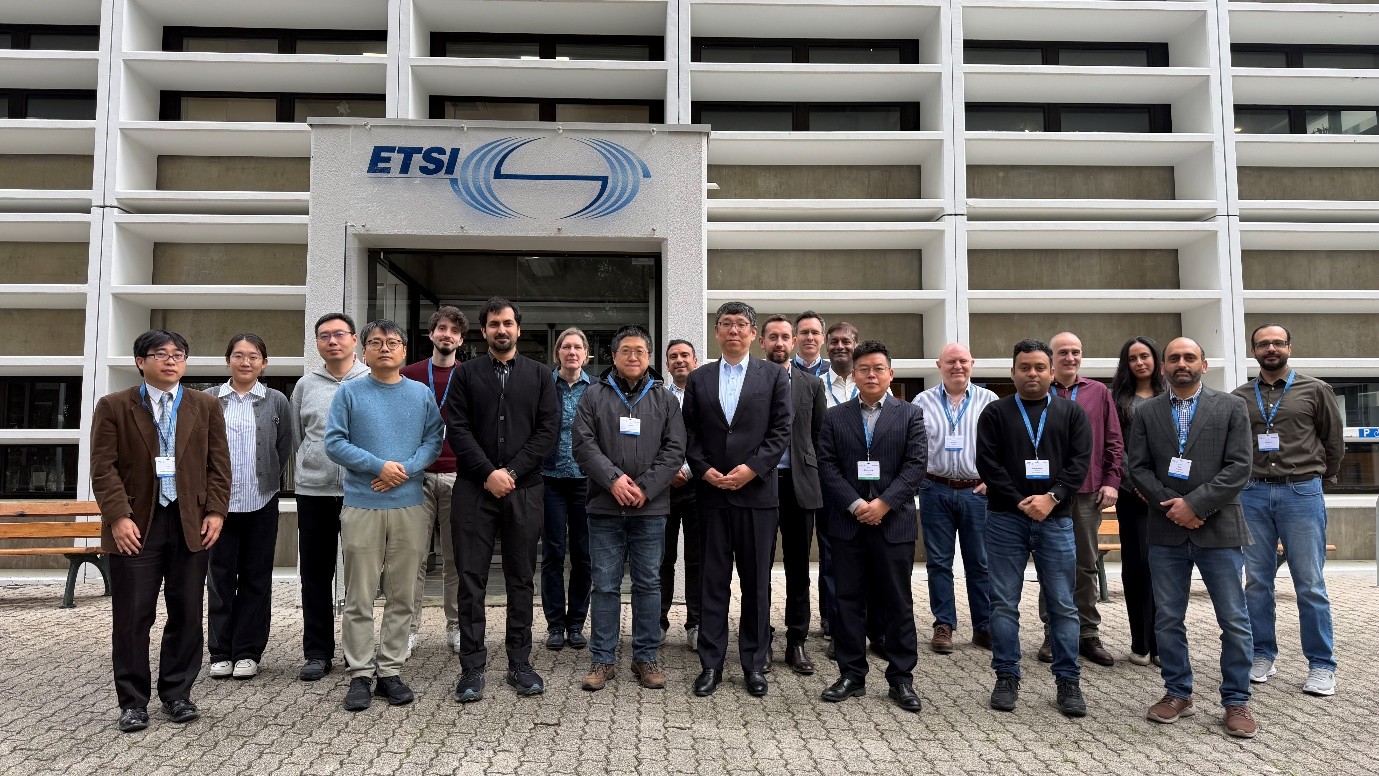
Group photo of NFV#53 conference participants standing in front of the ETSI headquarters building

Figure 1: ETSI ISG NFV in front of the ETSI headquarters